Pages

Friday, April 29, 2011

Samsung 4G advanced features of the epic


    On June 4, 2010, Sprint HTC Evo 4G, and WiMAX in the U.S. have started selling the first phone for Google's Android operating system and a great platform for streaming media, surfing Sprint's 4G network and the Internet and work. Evo Smart HTC Sprint 4G became the best selling book. Sold three times in the day of issue of previous visits, Sprint together with palm, the Samsung Instinct, prior to the first three days. HTC's Sprint store Evo 4G claimed some U.S. wireless carrier to "hot it led to a temporary shortage.

Sprint smartphone second, WiMAX launch of Samsung's 4G spectacular, August 31, 2010. It is mentioned in this article, along with the epic power of the enemy's industry-leading features that are expected to 4G on another bestseller. 3G subscribers, most of today, you can expect download speeds of 1 megabit per second. Nettowa 4G network per second, providing much faster than 6.7 megabits, about 10 times faster than third generation is finally over 3G networks. T - Mobile is it has no plans to build next-generation network, Verizon Wireless Inc., AT & T, followed in 2011, the year 2010 4G technology LTE (Long Term Evolution) will be expected to start It should be noted.


Samsung 4G features an epic post

Samsung is the largest of all types of mobile phone company's second. Samsung 4G epics, the updated software and a faster processor and bigger screen, using the best camera permanent camera a second to improve the smartphone market, keyboard, and fifth grade, social networks, and messaging and integrated, user-Water  pair box, add the quality of content is part of the company's plans. The galaxy is located in the Samsung series epic phone. It is full of 4G technology and the sliding, but because it has a physical keyboard, but it differs from other S Galaxy phone.


Friends

Super AMOLED is in. 4, 800 × 480 resolution, touch screen, thin display technology is currently on the market. The touchscreen to zoom, and a series of gestures to support advanced communications, including vertical and horizontal eliminate pinch. The wide viewing angle to prevent distortion and blurring, has a fast response time to reduce the impact of the image. 6-axis motion sensor has the ability to interpret a simple tweak movement, offers the best gaming experience. It also enables high-definition quality viewing experience, we offer the best representation of color cell phone compatible with the original content of more than 100 times compared to other major programs.

Physical / Virtual Keyboard

Line QWETRY - the keyboard has five slides. If you want to use a physical keyboard, the epic, comes with six virtual keyboard is possible. Mobile phone text input method you can slide your finger across the screen without having to remove you, and Samsung, Google has set the vertical and horizontal keyboard mode.

Double room

This is a 5-megapixel camera / Kameraotofokasu function and 3 × the power, VGA video recording (720p) from the face video chat with high-definition television recording and playback zoom high definition Before digital cameras and flash LED.

Processors

It is equipped with one - Tinnitus GHz processor A8 depends on three beautiful graphics applications bark - D upload time is a fast and rich, please download the full multimedia high-definition content quality . 3G and 4G WiMAX network Sprint CDMA network was working with Nettowa.

Google's Android software.

Samsung is the first epic, Google's Android operating system upgrades via the 2.2 Bluetooth 2.1 から 10 times Adobe Flash, voice dialing support, including implementation of external storage, the productivity of your browser To improve, robots will run next in the near future. Users of more than 65 000 useful applications to download to customize your experience, widget, you can access the Android game market.

Mobile Point

It is a time of 29.99 experience in 3G and 4G for the participation of five U.S. dollars per month additional fee Wi - Fi device can support.


Samsung's social hub

This center, social networking, consumer communications, personal and corporate email, calendar, contacts, and to integrate all services.

Sansei AllShare Service

This service is wirelessly share music, photos and HD video, and other , monitors, digital cameras and printers, including (DLNA compatible) based consumer electronics stores

Fuji Digital Camera Reviews History


Fuji digital cameras entered the market in the 90s. Starting in Japan in 1934, Fuji was always trying to stay ahead of the pack. The company's history is rather interesting so let's see it.


Starting in a small Japanese in the foothills of Mt. Fuji, Fuji Film Co. Ltd was established in 1934. At that time, nobody could imagine that such a small camera making company would become a million dollars globally known around the world in the next 50 years. Today, Fuji is known for greatdigital camera and innovative technology.


Fuji took 35 years to come to the United States. In the U.S., Fuji again started small with the establishment of six offices in the Empire State Building in New York City. In the span of four years, in 1969, the company has expanded itself so fast that
Morgan Guaranty Trust Company issued American Depository Receipts (ADRs) on Fuji Photo Film stock.


In 1976, Fuji Film launched the world's first ISO 400 color print film. This is the fastest color film still exist at the world during that time. Then, in 1980, Fuji launched the fastest color film movies - A-250. After this, Fuji became the official sponsor of the Los Angeles Olympics in 1984.

One of the biggest launch in the history of cameras made by Fuji was the QuickSnap in 1986. This was the QuickSnap one-time use camera and it became an instant hit in the market. Because of its usefulness, ease of use and convenience of the price, QuickSnap became the market leaders over time. Improvisation on the QuickSnap, Fuji introduced the world's first one-time use 35mm camera with flash in 1988.


Fuji is not a company that could be left behind as far as digital technology and digital cameras are concerned. Although Sony catch up Fuji in the race to introduce the first digital camera, Fuji gave the world the first digital camera with removable media in 1988.


Today, Fuji has established itself in the digital revolution. This continues to innovate its own and make several product launches such as the MX-700 in year 1998 and the world's smallest mega pixel digital camera light at that time. Fuji also has forays into digital printing technology.

Not only that, but Fuji is the conscience of the environment as well. In 2000, Fuji made contributions $ 7,800,000 in the construction of the Fuji Film Giant Panda Conservation Habitat in Washington DC in order to bring two giant pandas from China to the United States.

From cubic NANO Technology that enables digital video recording to enhance their recording capacity for 1000 two-hour film in 2001 with the xD-Picture Card, which is the smallest storage media on the market in 2002, Fuji continues to introduce new technology and newer digital today. Some of the newest digital cameras introduced today are:

A-Series: Automatic point-and-shoot cameras for basic users.

E-Series: Full featured, compact camera with manual controls as well.

F-Series: Ultra compact cameras in different styles with full features.

S-Series: Advanced cameras with optic controls for advanced users.

Series S-Pro: Highly sophisticated cameras for professionals.

Kevin Rockwell worked as a network TV cameraman for 20 years shooting news and sports. Now a devoted fan of digital photography and video he works to gather information, tips and news fordigital camera users. Oh and he likes to shoot pictures her children play sports.

Interesting Tips For Digital Camera


  • If you have digital camera and you can use the rechargeable battery. If you are going to buy battery, then you have to choose at least 1800 mAh.

  • If you want to save your battery in long time, then you never use your LCD except for macro and composition shots. You don’t use zoom lens. If you want to save your battery long time, then don’t connect your camera to your computer.

  • Carrying memory card is not whole as how you use it. if you have large memory cards and you want to prevent from losing all of your pictures  if the memory card is stolen, then you can try to rotate them as they get partially full.

  • The lower the resolution is lesser the details therefore you haven’t raise the resolution of an image.

  • If you want to save your camera from scratches and damages and dropping then you have to use the camera’s hand strap. Camera’s hand strap helps you to prevent your camera from dropping.

  • If you want to save your camera for long time, then you haven’t been so anxious to see your photos. At first take several pictures in a row and go back and look at them.

  • If your camera’s battery is slow and it will be slow down your camera so, you have to keep your camera’s battery fresh.

  • If you want to save your camera, then just zoom to your camera lens back after move the camera closer to keep the subject in focus. You haven’t used your flash.

  • If you have digital camera. Then it is necessary to know your camera’s light and beeps because it has become your camera’s battery slow down.

  • Sunday, March 13, 2011

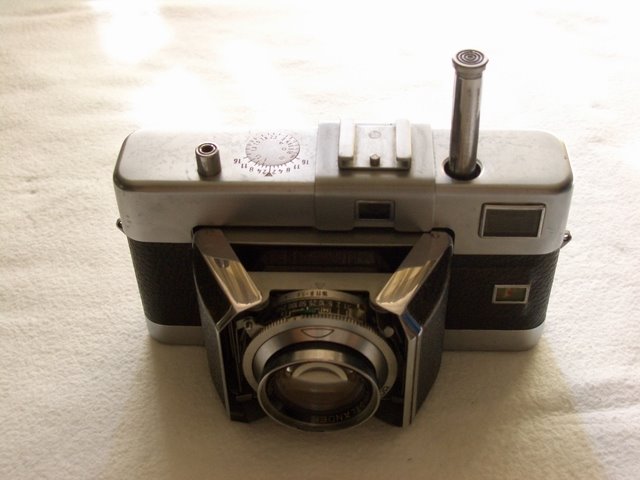
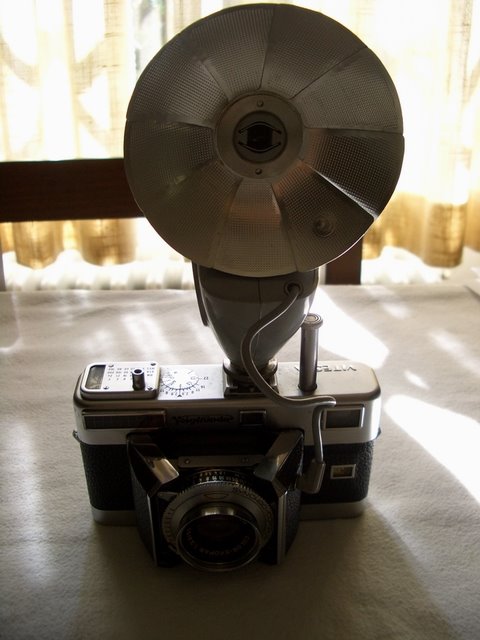
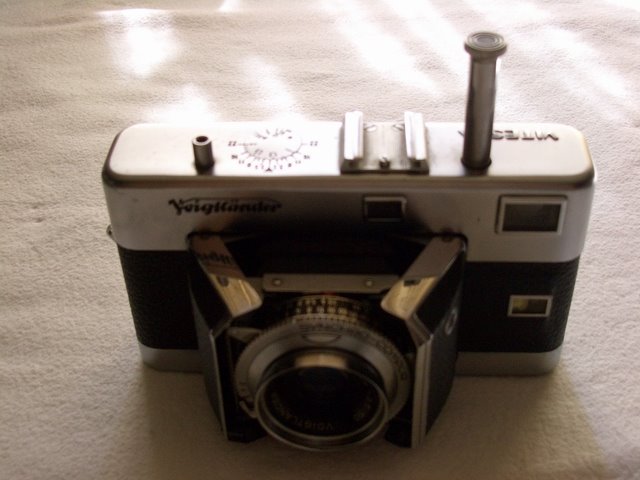
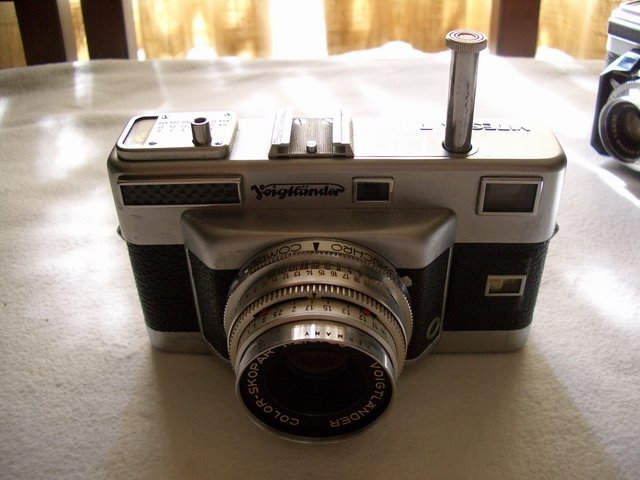
    Voigtlander Vitessa


    Prodotta in vari tipi dal 1953 al 1960 in circa 350.000 esemplari, ha come particolarità il fatto di essere una macchina a soffietto con due sportelli frontali.
    Solo l'ultimo tipo, la Vitessa T, non presenta il soffietto e ha obiettivi intercambiabili. Altra particolarità era il sistema di caricamento della pellicola 35mm a stantuffo.
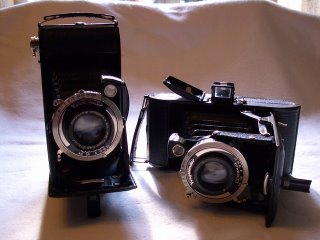
    La Vitessa 132 venne prodotta dal 1953 al 1954. I primi modelli erano dotati di un otturatore Compur Rapid che venne sostituito con il Synchro Compur. L'obiettivo era un Ultron 2-50mm. I modelli del 1954 sono dotati anche di slitta per il flash fissa mentre le precedenti ne avevano una amovibile.


    La Vitessa 134 detta anche Vitessa II prodotta dal 1955 al 1957 è molto simile all'ultimo modello della precedente, ha la
    slitta fissa, l'otturatore Syncro compur ma oltre all'obiettivo Ultron esistono modelli con il più economico Color Skopar
    2,8-50mm.
    La Vitessa 133 detta anche Vitessa IIIL prodotta nel 1957 differiva dal modello 134 in quanto era equipaggiata con un
    esposimetro al selenio e da un più preciso otturatore. Anche questo modello era disponibile o con lente Ultron o con lo Color Skopar.


    La Vitessa IIIN prodotta nel 1957 era identica alla precedente senza esposimetro e montava solo la lente Color Skopar 3,5-50.

    La Vitessa T prodotta dal 1956 al 1960 presenta delle sostanziali modifiche: viene abbandonato il soffietto per fare spazio alla possibilità di avere obiettivi intercambiabili. Ha un otturatore Syncro Compur, l'esposimetro al selenio e poteva montare un ampia scelta di lenti: Color Skopar 2,8-50, Skoparet 3,4-35, Dynaret 4,8-100, Super Dynaret 4-135.
    Come per la Prominent era disponibile come accessorio la custodia flash.


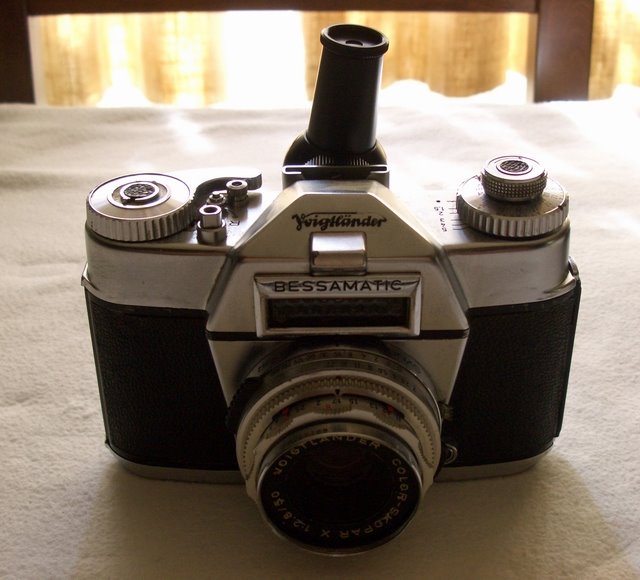
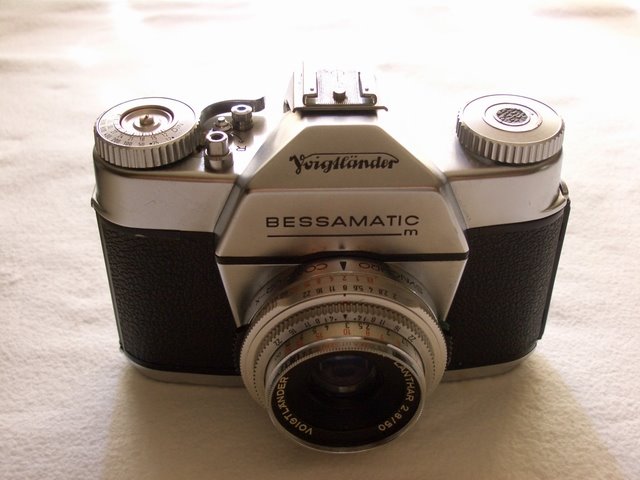
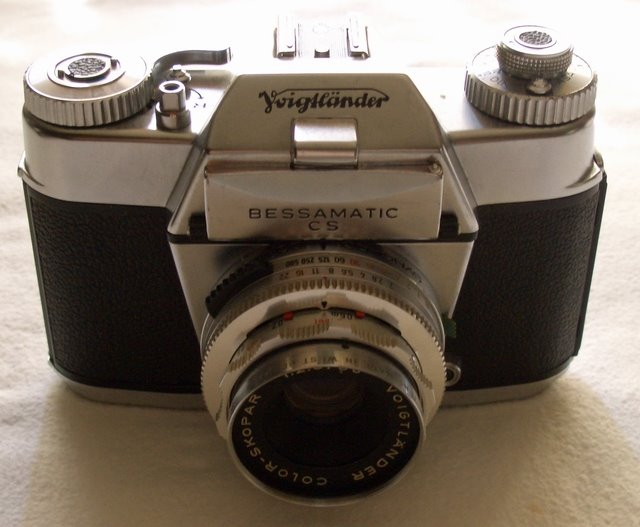
    Voigtlander Bessamatic


    Questa reflex a prisma con obiettivi intercambiabili venne prodotta dal 1958 al 1969 ovviamente in vari modelli con sostanziali modifiche. La particolarità di questa macchina è che fu la prima a montare uno zoom lo Zoomar 36-82mm un vero "cannone" visto con i canoni odierni.
    I primi modelli erano dotati, per l'esposimetro, di cella al selenio metre gli ultimi saranno elettronici a pila. L'otturatore è per tutte le macchine un synchro compur da 1 - 500.


    Il primo modello di Bessamatic fu prodotto in circa 140.000 esemplari; il modello
    successivo, la Bessamatic de Luxe (caratterizzata da un periscopio che permette di
    controllare la velocità dell'otturatore direttamente dall'oculare) fu prodotta in circa
    75.000 esemplare. Dopo queste due fu prodotta la Bessamatic m, la versione economica senza esposimetro, in circa 6.900 esemplari e
    la Bessamatic CS (caratterizzata dall'allogiamento della pila per l'esposimetro ditro la
    scritta al posto della cella al selenio) in circa 22.000 esemplari.


    La Bessamatic venne prodotta dal 1958 al 1963, la Bessamatic de Luxe dal 1962 al 1966, la
    Bessamati m dal 1962 al 1966 e la Bessamatic CS dal 1966 al 1969.

    Voigtlander Bessa 46 e Bessa 66


    Questa serie di piccole bessa (da qui il nome baby bessa o kleine bessa) inizia nel 1938 e finisce nel 1950 è quindi in tutto e per tutto figlia della Bessa.
    Come è facile da intuire la Bessa 46 aveva formato 4,5x6 mentre la Bessa 66 aveva formato 6x6. I primi modelli avevano l'oculare mobile mentre invece gli ultimi modelli l'oculare integrato nella macchina. Quasi tutte
    avevano il filtro direttamente collegato all'obiettivo.Non c'è molto da dire anche perchè erano macchine fotografiche economice per il tempo.

    Voigtlander Inos e Inos II


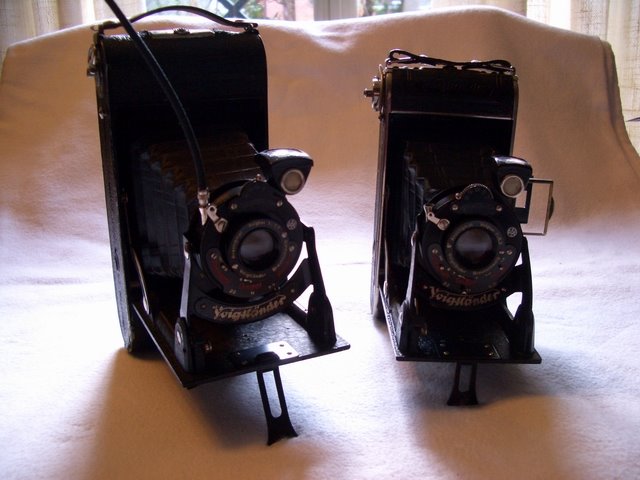
    La produzione di queste macchine a rullino 6x9 iniziò nel 1931 e finì nel 1935. Dal '31 al '33 vennero prodotte circa 10.000 Inos I e dal '33 al '35 circa 60.000 Inos II.
    Il primo modello è molto semplice e non si differenzia troppo dalle Rollfilm già prodotte dalla Voigtlander;la Inos II invece riprende un po' lo stile delle sue contemporanee di lusso come la Perkeo 3x4, la Virtus e la Prominent 6x9, presenta infatti la tipica rotella di avanzamento della pellicola usata in queste macchine.Della Inos II esiste inoltre una rara versione in formato 6,5x11.

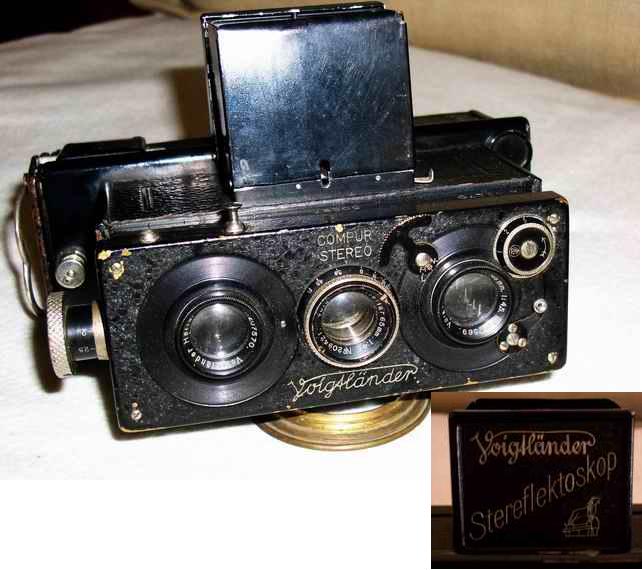
    Voigtlander Stereo


    La produzione di macchine fotografiche stereo
    Voigtlander iniziò nei primi anni del '900
    con il modello Stereophotoskop per poi evolversi, a partire dal 1913, con i modelli della
    serie Stereflektoskop.Interessanti in quest'ultima gamma di apparecchi fotografici, sono i retro dei pozzetti,
    caratterizzati da varie scritte o dal celebre Leone di Braunschweig che rimarrà come
    simbolo anche nelle pubblicità anche in tempi più vicini a noi.


    Da notare che la Stereflektoskop venne prodotta dal 1913 al 1947 in due formati:
    il 45x107 e il 60x130 e l'ideatore non fu altro che il Sig. Heidecke che, con il celebre
    socio Franke, produsse le celebri Rollei Heidoscop e Rolleidoscop tanto somiglianti alle
    Voigtlander stereo.


    Voigtlader Bergheil


    Il vanto della Voigtlander nei lontani anni venti. Questa lussuosa macchina fotografica a
    soffietto era per l'epoca un vero e proprio bene di lusso. Il nome deriva dal saluto che gli alpinisti si scambiano una volta raggiunta l'agognata vetta. In produzione dal 1911 al 1936 in, ovviamente, tantissime varianti e modelli per un totale di circa 80.000 pezzi. Le prime erano caratterizzate da dei braccetti metallici che sostenevano il soffietto fino alla massima estensione, i modelli più recenti sono caratterizzati dal mirino senza vetro e dalle bolle sui pomelli di regolazione.
    Esistono inoltre modelli in pelle verde che normalmente vengono considerati più rari e quindi più preziosi oltre al modello più raro in assoluto che è quella con la pelle marrone.


    Bella Bilora

    Voigtlander Bessa


    Sicuramente la macchina fotografica Voigtlander di maggior diffusione e la più longeva costruita in più di un milione di esemplari. La produzione della Bessa, economica ed affidabile, inizia nel 1929 e termina nel 1957 con la ricercatissima Bessa II. Ovviamente si susseguirono molti modelli con numerose innovazioni tecniche. Da notare che nei modelli a partire dal 1948 venne introdotto anche il telemetro. La prima Bessa è riconoscibile dalla tipica scritta frontale "Portrait-Gruppe-Landschaft" che in rari modelli è tradotta nella lingua del paese in cui veniva esportata (ne posseggo una con le scritte in italiano cosa non difficile da spiegare in periodo di forzata autarchia).


    Questo primo modello di Bessa venne prodotto nel 1932 anno in cui inizio' la produzione della "Nuova Bessa".


    Proprio nel 1932 venne però prodotta in pochissimi modelli una sorta di via di mezzo che utilizzava la "scocca" di un'atra macchina fotografica contemporanea: la Inos II. Questo modello viene definito dai collezionisti Bessa Chain Gang in quanto ha la rotella di avvolgimento pellicola uguale alla Inos II, alla Perkeo 3x4, la Virtus e la Prominent 6x9.


    Come accennavo prima dal 1932 al 1938 venne prodotta la Nuova Bessa. Oltre al design migliorato si ha come innovazione tecnica l'otturatore azionabile da una levetta che sporge dallo sportello quando la macchina è aperta; molto comodo da usare con la macchina in posizione orizzontale. Questo modello aveva all'inizio un mirino esterno ripiegabile senza vetro in seguito venne introdotto un mirino a molla munito di vetro.


    Dal 1936 iniziò la produzione di una Bessa munita di telemetro. Le Bessa prima della II Guerra Mondiale sono caratterizzate
    dal filtro giallo collegato con una cerniera all'obiettivo, quelle a partire dal 1948 non hanno questo accessorio fisso.Oltre a questo modello sicuramente lussuoso per l'epoca, dal 1947 al 1950 venne prodotta una macchina simile all'ultimo
    modello di Nuova Bessa con lenti Color Skopar 3,5 - 105 o Vaskar 4,5 - 105 con otturatori Prontor S o Compur Rapid.La bessa diede origine ad altre macchine come le Baby Bessa 46 e 66, la Bessa I e la Bessa II.


    Voigtlander Prominent 6x9

    Voigtlander Prominent 6x9

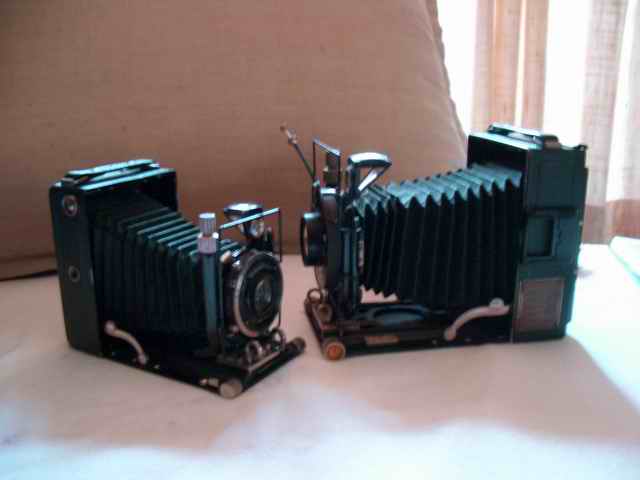
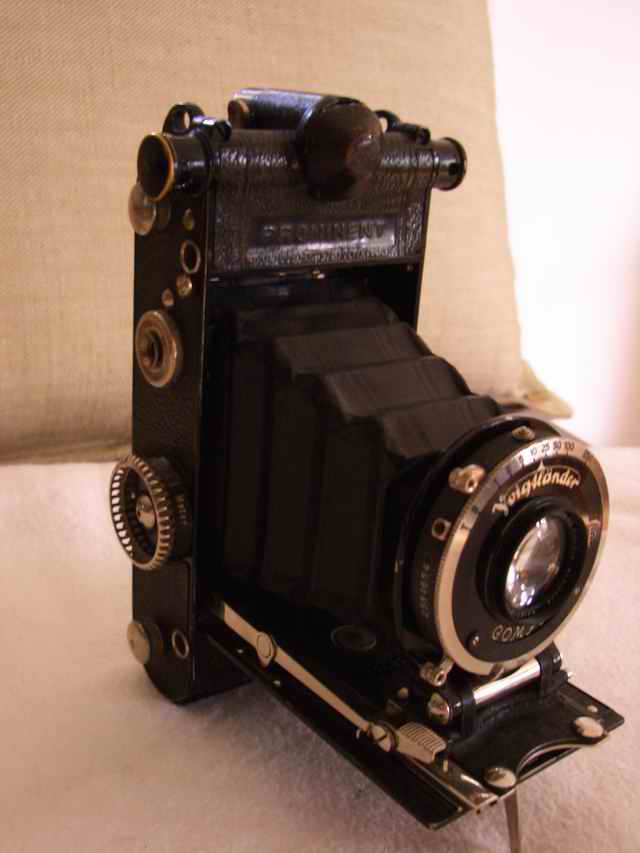
    Sicuramente una delle Voigtlander migliori e più ricercate dai collezionisti anche se, sicuramente, una delle più costose. Questa fantastica regina delle macchine a soffietto fa capolino nel mercato europeo nel 1932 e fu prodotta in circa 4.000 esemplari fino al 1932. Della stessa "famiglia" fanno parte altri due magnifici modelli, la Perkeo 3x4 e la
    Virtus, che vi descriverò in seguito. Per l'epoca era una vera e propria "Ferrari" munita di telemetro, esposimetro a estinzione e una magnifica lente Heliar 4,5-105mm. L'otturatore era, nella maggior parte dei modelli, un precisissimo Compur da 1 a 1/250sec. in alternativa produssero un esiguo numero di pezzi equipaggiati con un otturatore Turbo da 1 a 1/400 che rappresenta il vero e proprio sogno proibito per ogni collezionista. Il formato della pellicola è il 6x9 che però può diventare 3x4 usando delle piccole riduzioni che erano in dotazione con la macchina. Nel libro di Udo Afalter sulle Voigtlander viene anche menzionata una rarissima versione in pelle verde (come le Bergheil suppongo) ma, non solo non ne ho mai vista una, ma non ne ho mai sentito neanche parlare.

    Voigtlander Perkeo 3x4

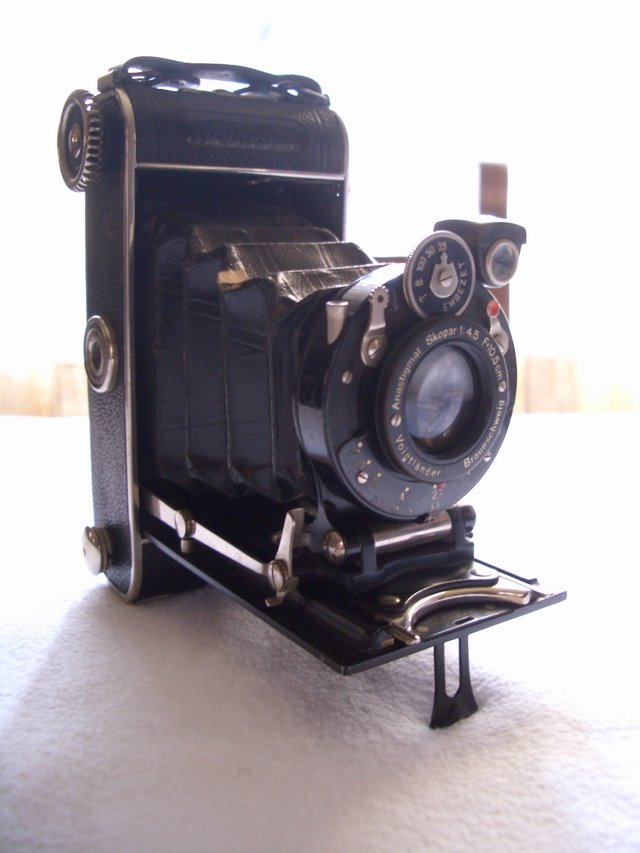
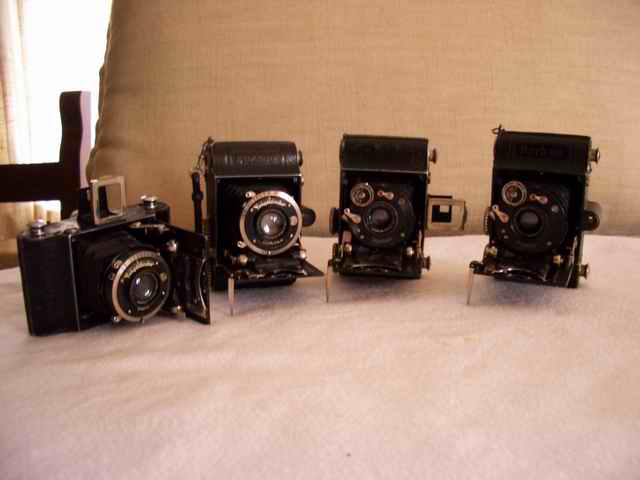
    Anche questa macchina era contemporanea alla Prominent 6x9 e alla Virtus. A dire il vero era la più piccola e la più simpatica anche a livello visivo. Fu prodotta in circa 10.000 esemplari tra il 1931 e il 1935. I primi modelli avevano il mirino ripiegabile e senza lente, successivamente fu sostituito da un mirino fisso e integrato nel corpo della macchina. Montava anch'essa lenti Skopar o le più performanti Heliar e come otturatori il Compur o l'Embezet. Magnifico è il sostegno (nelle versioni più nuove) che permette alla macchina di stare dritta. Non esce da sotto lo sportello come nella Virtus o nella prominent ma fuoriesce dal lato ed è possibile ripiegaro all'interno della macchina (di fianco al soffietto) prima di chiuderla.

    La collezione è attualmente composta da 4 modelli:
    - lente Skopar 4,5-55 otturatore Embezet 1-1/100 mirino mobile quadrato
    - lente Skopar 4,5-55 otturatore Embezet 1-1/100 mirino integrato tondo
    - lente Skopar 3,5-75 otturatore Compur 1-1/300 mirino mobile quadrato
    - lente Skopar 3,5-55 otturatore Compur 1-1/300 mirino integrato tondo

    Canon A1

    Minox 35 ML

    Minox 35 ML

    Related Posts Plugin for WordPress, Blogger...

    Popular Cameras